
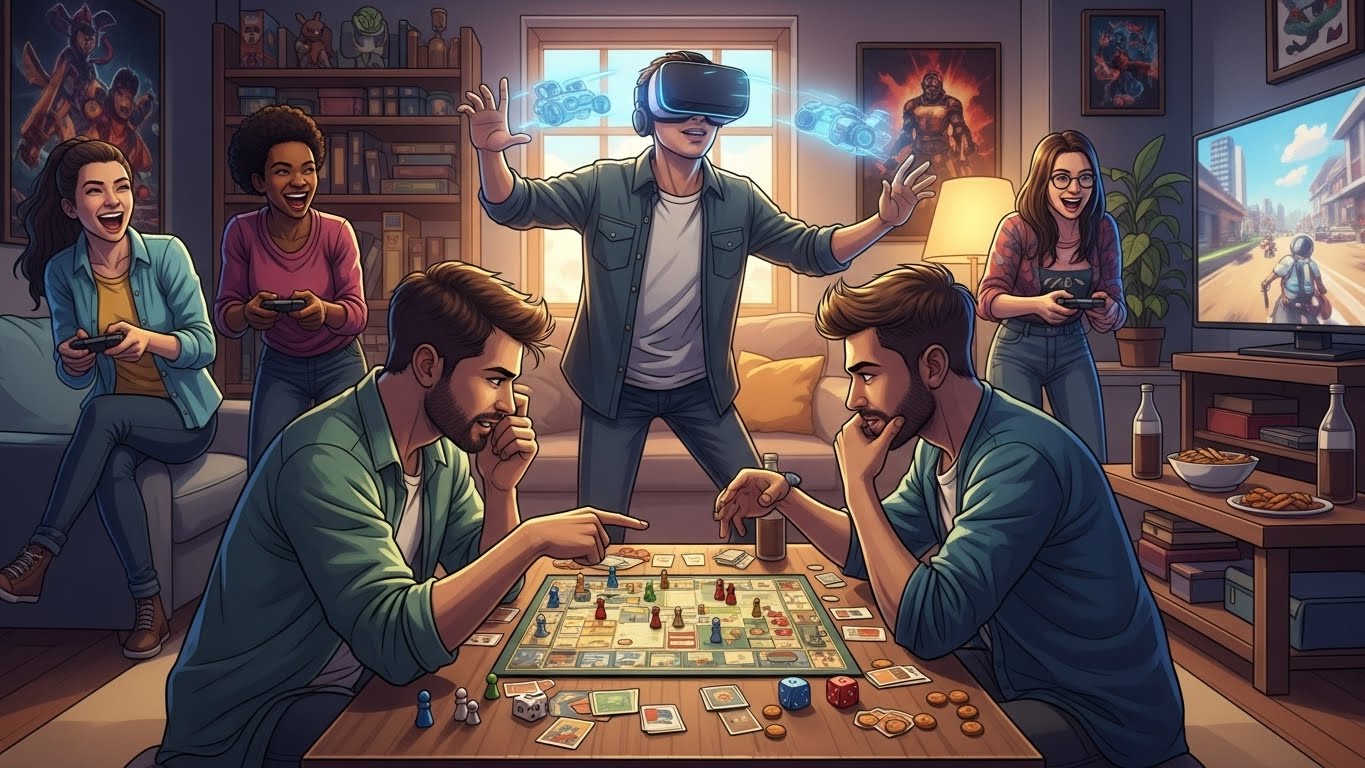
Video games have always been a medium for innovation, creativity, and endless possibilities. While many games share common mechanics or concepts, there are titles that stand out due to their originality and fresh approaches. These games offer experiences that transcend traditional gameplay, blending artistry, storytelling, and gameplay mechanics in ways that feel entirely new. In this post, we’ll explore the significance of unique game titles, the features that set them apart, and the impact they have had on the gaming industry.
The Evolution of Game Design
To truly appreciate the games with unique titles, we first need to understand how video game design has evolved over the years. Early games were simple—arcade classics like Pong and Space Invaders defined an era with their minimalist design and repetitive mechanics. As technology advanced, so did the complexity of the games, moving from pixelated graphics to immersive 3D worlds. However, despite the rapid advancements in technology, the underlying principles of game design often remained unchanged: goals, obstacles, rewards, and progression.
The turning point came when developers began experimenting with new ways to engage players. They moved beyond traditional mechanics and sought to create something more—something that would surprise players and challenge their expectations. This led to the creation of games that defied conventional genres, incorporating narrative, emotional depth, and gameplay that didn’t follow the usual formulas.
The Appeal of Unique Games
What makes a game truly unique? Is it the art style, the narrative, or the mechanics? In truth, it’s often a combination of these elements. A unique game experience can be defined by its ability to challenge the player’s understanding of what a game can be. These games don’t simply ask players to complete tasks—they invite them into worlds that are strange, thought-provoking, and often unlike anything they’ve experienced before.
One of the most attractive aspects of unique games is the sense of discovery. Players are drawn to the unknown, to experiences that don’t rely on familiarity. In a sea of sequels and franchises, innovative games offer a refreshing change, forcing players to think outside the box. They might be experimental in terms of their storytelling or gameplay mechanics, creating something unfamiliar yet undeniably intriguing.
Examples of Unique Games
Journey (2012)
Journey is often hailed as one of the most unique and emotionally resonant games ever made. Developed by Thatgamecompany, Journey is a minimalist game that defies traditional mechanics. It’s a game that requires little explanation—players control a robed figure as they traverse vast desert landscapes toward a distant mountain. What sets Journey apart is its emphasis on emotional experience over traditional gameplay.
The game features no dialogue, no inventory system, and no combat. Instead, it focuses on exploration and emotional connection. The beauty of Journey lies in its simplicity: every aspect of the game is designed to evoke a feeling of wonder and awe. The online multiplayer component is equally groundbreaking, as players can encounter other human players without any communication other than subtle gestures. The anonymity fosters a sense of cooperation, as players help each other without knowing each other’s identity.
The experience of Journey is a journey in itself—one that relies on atmosphere, sound design, and visual storytelling rather than complex mechanics or narrative-heavy content. It’s a testament to the idea that a game doesn’t need a traditional structure to be impactful. Instead, it can be an abstract exploration of emotions and connection.
The Stanley Parable (2013)
The Stanley Parable is another example of a game that defies conventions, turning the concept of choice and narrative on its head. In this interactive fiction, players assume the role of Stanley, an office worker who finds himself alone in a strange, empty building. The narrator guides Stanley’s actions, presenting players with choices that can lead to various outcomes, but what makes the game truly unique is that these choices often lead to absurd, nonsensical, or even pointless results.
What sets The Stanley Parable apart is its commentary on choice in video games. Rather than simply providing players with multiple paths to explore, the game actively questions the idea of choice and free will in gaming. The narrator frequently breaks the fourth wall, mocking the player’s decisions, forcing them to confront the limitations of the interactive experience. It’s a game that actively resists traditional storytelling, making players question the very medium they’re engaging with.
The game’s satirical tone and willingness to subvert expectations make it a standout example of how video games can challenge players intellectually and philosophically. It’s not just a game to be played—it’s a game to be reflected upon.
Antichamber (2013)
Antichamber is a mind-bending puzzle game that distorts the very concept of space and physics. Developed by Alexander Bruce, Antichamber takes place in an ever-changing, Escher-like environment where the laws of reality don’t always apply. The game doesn’t provide players with traditional instructions; instead, it encourages exploration and experimentation, with puzzles that require creative thinking rather than logic or prior knowledge.
The most striking feature of Antichamber is its use of spatial puzzles. Hallways loop back on themselves, doors lead to unexpected locations, and the player must rely on their intuition rather than traditional game mechanics. The game is not about mastering the rules—it’s about redefining them. This results in an experience that feels disorienting but incredibly rewarding. The game constantly challenges players to rethink their assumptions, making it a truly unique entry in the puzzle genre.
Outer Wilds (2019)
Outer Wilds is a space exploration game that combines mystery, science fiction, and the joy of discovery. In this game, players take on the role of an astronaut in a small solar system, where they must investigate a series of strange occurrences, most notably the repeated destruction of the entire solar system every 22 minutes. What makes Outer Wilds so unique is the way it incorporates time loops, environmental storytelling, and open-world exploration into a single cohesive experience.
Unlike most games where players can simply explore an open world at their own pace, Outer Wilds uses the time loop mechanic to push players to learn and adapt. Every 22-minute cycle gives players a chance to uncover more of the solar system’s mysteries, but it also forces them to work within the constraints of time. This time loop is both a challenge and an opportunity, as it gives players the ability to experiment without fear of permanent failure. The game doesn’t hold the player’s hand; instead, it encourages self-guided discovery and curiosity.
The sense of wonder and awe in Outer Wilds is hard to replicate in other games. The experience of exploring a vast, mysterious universe that is constantly on the verge of destruction is thrilling and thought-provoking. It’s a perfect example of how a unique concept—time loops—can be used to create an entirely new genre of gaming.
The Impact of Unique Games
Unique games have a lasting impact on the gaming landscape. They inspire future developers to think outside the box, encouraging experimentation and pushing the boundaries of what games can be. Titles like Journey, The Stanley Parable, Antichamber, and Outer Wilds demonstrate that there’s no single formula for success in the gaming industry. Instead, innovation and creativity are often the keys to creating memorable, impactful experiences.
These games prove that there’s more to gaming than just complex mechanics or cutting-edge graphics. At their core, the best games are those that offer players something new—whether it’s an emotional connection, a philosophical exploration, or a playful twist on genre conventions.
Conclusion
In the world of gaming, uniqueness is a rare and precious commodity. While the industry is often dominated by sequels, franchises, and familiar formulas, there are always a select few games that manage to break free from the mold. These games offer players something different: a chance to experience art, philosophy, and innovation in a way that feels fresh and new.
Whether through minimalist design, narrative subversion, or mind-bending puzzles, these titles remind us that video games are more than just entertainment—they are a medium for creativity and expression. And while unique games may not always have mass appeal, they are the ones that often leave the biggest impression, paving the way for the future of game design.
In a landscape filled with endless possibilities, it’s the unique games that continue to capture the imagination and inspire the next generation of developers to dream big.